Discover the rich, centuries-old tradition of the Eritrean and Ethiopian coffee ceremony – and why at Asmara Bella, we consider it the heart of our hospitality.
In Eritrea and Ethiopia, coffee is not simply a drink. It is a ceremony, a ritual, and a form of communion that has been practised for centuries.
The ceremony – known as Buna in Ethiopia and Boon in Eritrea – begins with the roasting of fresh green coffee beans over charcoal. The rising smoke and the deep, nutty aroma that fills the room signal to guests that they are welcome, that time will slow down, and that conversation is about to begin.
Where coffee began
The coffee plant grows wild in the highland forests of Ethiopia, and this corner of East Africa is where people first learned to roast and brew its beans. It is no surprise, then, that coffee is woven so deeply into daily life here. The ceremony is how families welcome neighbours, mark celebrations and simply make time for one another – often more than once a day.
Setting the scene
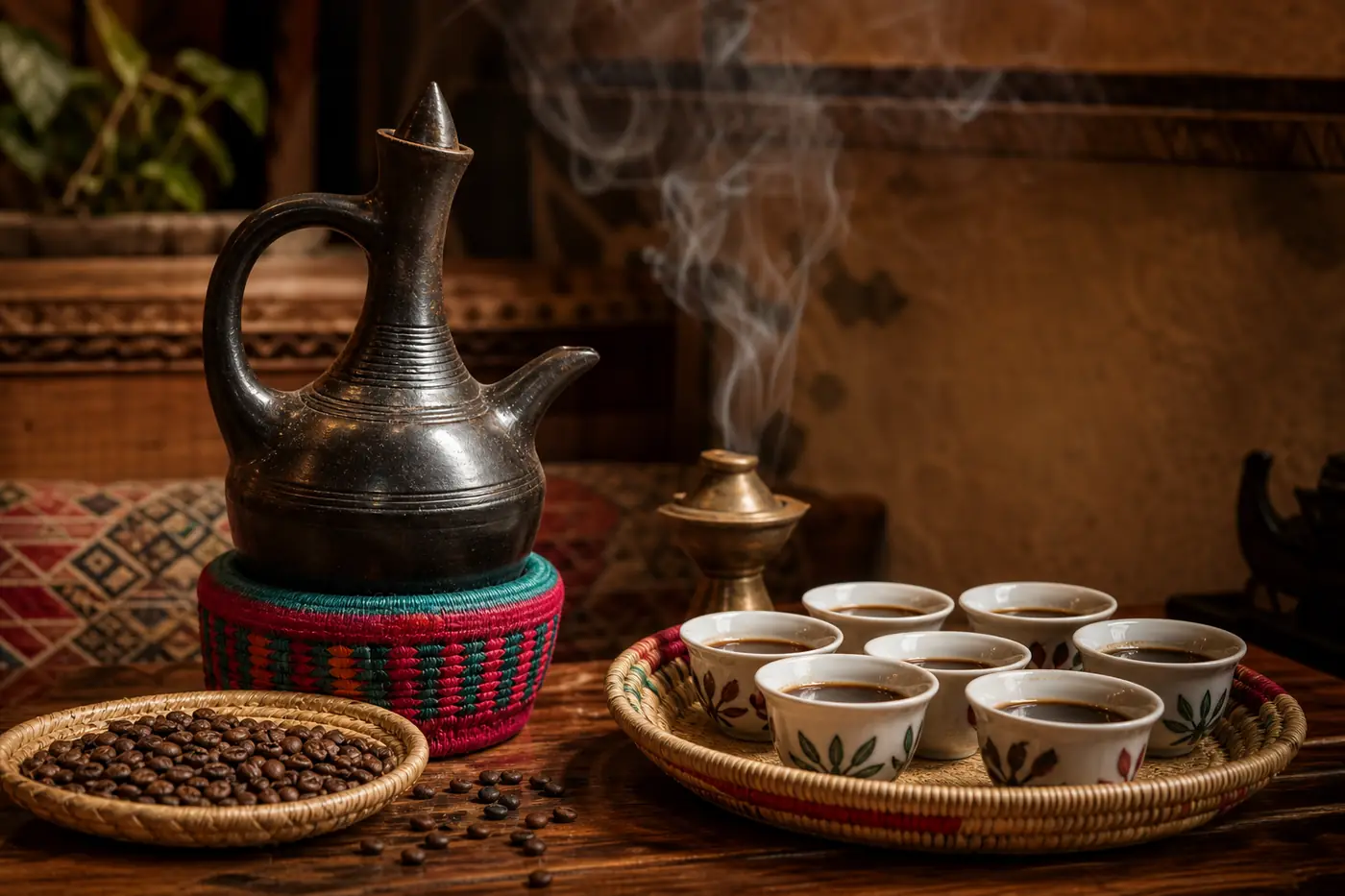
A ceremony is usually led by one person, traditionally a woman of the household. Small handleless cups are arranged on a tray, frankincense is lit so that its sweet smoke drifts through the room, and fresh grass or flowers may be scattered nearby. At the centre sits the jebena: a round-bellied clay coffee pot with a long, slender neck.
Step by step
- Washing and roasting. Green beans are rinsed, then roasted in a shallow pan over charcoal, stirred constantly until they turn dark and glossy and begin to crack.
- Sharing the aroma. The hot pan is carried around so that each guest can wave the fragrant smoke towards them – an invitation to the ritual.
- Grinding. The roasted beans are ground by hand, traditionally with a wooden mortar and pestle.
- Brewing. The ground coffee is added to water in the jebena and brought to the boil, then left to rest so the grounds settle.
- Pouring. The coffee is poured from a height in a single, unbroken stream, filling every cup without stopping – a skill that takes years to perfect.
Three rounds of coffee
Tradition dictates that coffee is served in three rounds: Abol (the first, strongest cup), Tona (the second, slightly weaker), and Baraka (the third – meaning blessing). To leave before the third cup is considered impolite. To stay for all three is to receive a blessing.
Each round uses the same grounds with fresh water, so the coffee grows gentler as the conversation deepens. Coffee is often taken with sugar, and the cups are accompanied by a simple snack.
Coffee ceremony etiquette
- Accept at least one cup – and if you can, stay for all three.
- There is no rush. The ceremony can take an hour or more; that is the point.
- A word of thanks or praise to the person pouring is always appreciated.
The coffee ceremony at Asmara Bella
At Asmara Bella, our Coffee Ceremony is served in the authentic style – roasted, ground, and brewed at the table, accompanied by popcorn or kolo (roasted barley). It is more than an after-dinner drink. It is an experience.
Our coffee ceremony is available for 1–4 people (£12.50 for one, £18 for two, £25 for three and £30 for four). Groups of 2 or more are encouraged to share the ritual together – because that, after all, is the whole point. You can also add it to your table when you book online, or learn to make it yourself in our coffee making class.
Read more about the ritual on our coffee ceremony page.